




Food and Drug Branch (FDB)
FDB Home Page
Contact
Main Telephone:
(800) 495-3232
Email:
Address (Courier Delivery):
California Department of Public Health - Food and Drug Branch
1500 Capitol Ave, MS 7602
Sacramento, CA 95814
Address (Non-Courier Delivery):
California Department of Public Health - Food and Drug Branch
P.O. Box 997435, MS 7602
Sacramento, CA 95899
Organic Food Processors
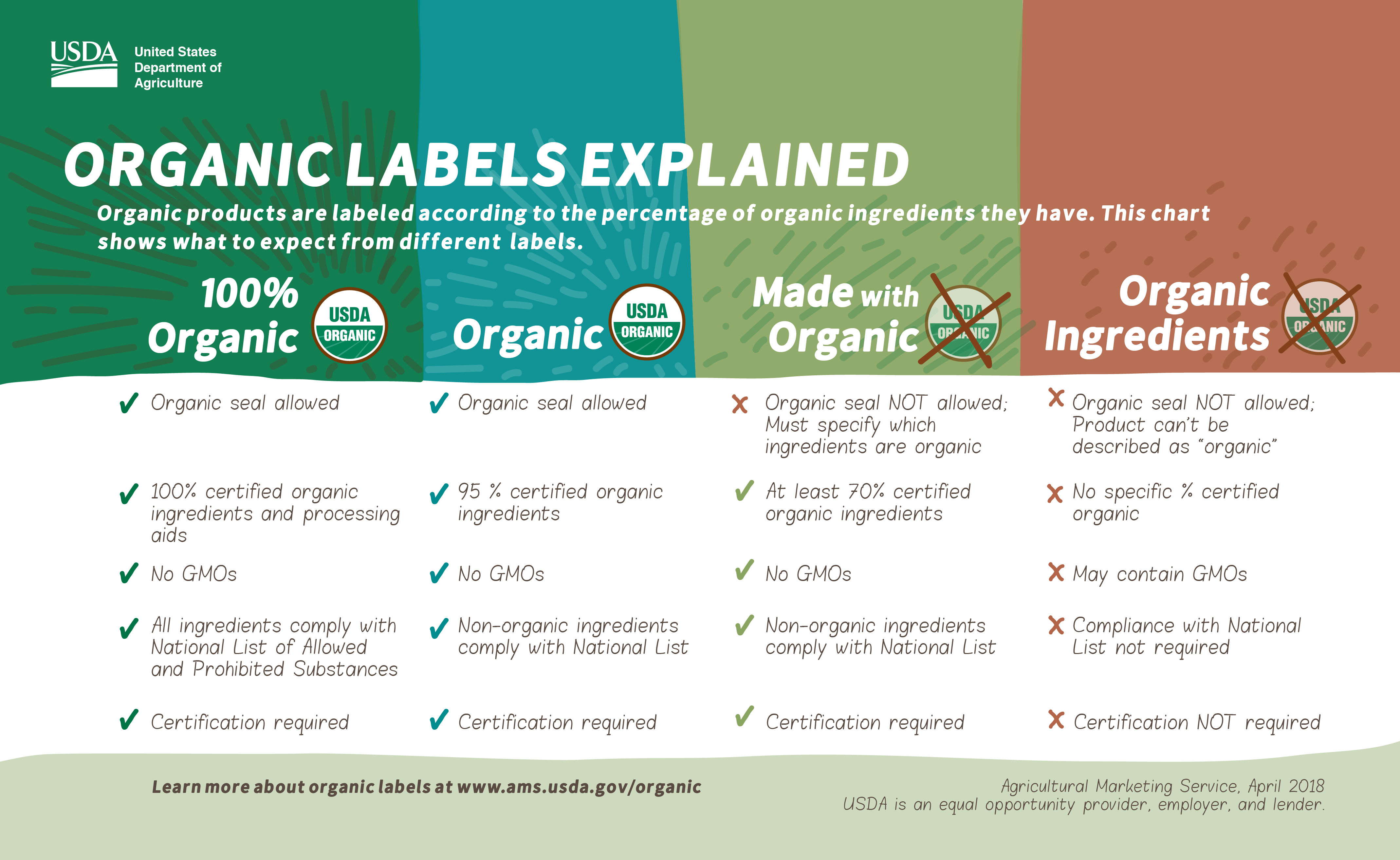
Organic is a term that indicates that the food or agricultural product has been produced using sustainable practices and without synthetic fertilizers, sewage sludge, irradiation, or genetic engineering. Products may be labeled “100% organic,” “organic” or “made with organic.”
Food products labeled as “100% organic” must consist entirely of organic ingredients; food products labeled “organic” must consist of 95% certified organic ingredients; and food products labeled “made with organic” must contain at least 70% certified organic ingredients (minus water and salt). Food products containing 95% or more organic content may use the USDA Organic Logo on their product labels or advertising. Unless exempted or excluded under the National Organic Program (NOP) rules, all organic food products must be certified by an accredited certifying agency (ACA), and the ACA must be identified on the product label.
Cosmetic and personal care products, although not covered under the National Organic Program (NOP) regulations established for food, can be labeled as “organic” or “made with organic” under California law if the cosmetic contains a minimum organic content of 70% (minus water and salt). If a cosmetic is able to meet the NOP [food] standards, the cosmetic can be certified and labeled in accordance with NOP rules. Cosmetics sold as organic cannot be labeled or advertised in a way that would lead consumers to believe they are certified organic or in compliance with NOP requirements, unless they are certified under the NOP regulations.
Organic Oversight - Laws and Regulations
Laws relating to the handling of organic foods are codified in the federal Organic Foods Production Act of 1990, the California Organic Food and Farming Act (COFFA), and the National Organic Program (NOP) Regulations (which California adopts).
The California Department of Public Health (CDPH) and the
California Department of Food and Agriculture (CDFA) work cooperatively with the
US Department of Agriculture (USDA) to enforce the organic regulations within
California. CDPH oversees processors and handlers of organic food,
pet food, and cosmetics, and CDFA oversees organic agricultural production, milk
and dairy food processing, meat and poultry processing, and retail organic
production activities. Use this infographic (PDF) to provide clarification about which department to register with.
If an operation’s annual gross sales of organic food are greater than $5,000 they are required to obtain certification from an accredited third-party certifier, who will verify the sourcing of the agricultural inputs, verify the organic content of processed products, and ensure that operations are conforming with NOP regulations. A link to the list of certifiers operating in California can be found below.
Organic Registration
COFFA requires every person to obtain an Organic Processed Product Registration (OPPR) from CDPH, if they process or handle processed food or cosmetics that are “sold as organic.” Operations that process organic products at retail must register with CDFA. The term ”sold as organic” means any use of the terms “organic,” “organically grown”, or like terms on any aspect of the product advertising or labeling, including on the principal display panel, information panel or in the ingredient statement.
Most organic food processors and handlers cannot be issued an OPPR unless they possess a valid Processed Food Registration (PFR) from CDPH. The Processed Food Registration acts as a basic health permit authorizing the company to engage in food processing and handling. It is required regardless of the food being conventionally or organically produced. Links to the registration applications are available below.
Not all handlers of organic processed food products have a food
processing facility. Brokers, importers, or firms selling organic product
which are produced on their behalf by a contract manufacturer or co-packer,
must register under OPPR. No Processed Food Registration is required,
provided that the firm does not take custody of any of the products.
Individuals that contract with another company to manufacture an organic food
product on their behalf must obtain an OPPR as a handler. Cottage Food Operations (CFO’s) are required to register with the California Department of Food and Agriculture’s State Organic Program.
Organic Complaints
If you would like to file a complaint regarding an organic
product, please visit the FDB Complaints Webpage for more information.
Applications and Forms
Organic Processed Product Registration: CDPH 8593 (DocuSign)
Please note: For DocuSign applications, after fully completed, please print and remit with payment to the address on the instructions page of the application. We do not accept these electronically.
Processed Food Registration: CDPH 8610 (PDF) (To be used by all counties except Los Angeles, Orange, and San Bernardino)
Processed Food Registration: CDPH 8611 (PDF) (To be used by Los Angeles, Orange, and San Bernardino counties only)
Laws and Regulations
Resources
CDFA California State Organic Program - Cost share Information and Application Packet
Accredited Certifiers Operating in California (PDF)
California Department of Public Health Organic Program Review of 2023 (PDF)
Do I Need to Be Certified? (PDF)
California Department of Food and Agriculture Organic Program
PM 11-8 California State Organic Program, Additional Requirements Approved (PDF)
New Rule: Strengthening Organic Enforcement
Organic Product/Commodity CDFA or CDPH Jurisdiction List
Do I Register with CDFA or CDPH? (PDF)