





Case Report: 22CA002
Download a PDF to print this report: Warehouse Worker Dies When Material Falling Off of Pallet Strikes Him (22CA002, PDF)
Summary
On May 13, 2022, a 39-year-old male warehouse worker was acting as a ‘spotter’ and assisting a forklift operator who was moving pallets of cased bottled water near the end of the night shift. The pallets were shrink wrapped, double stacked, and combined stood about 9 ½ feet high. As the forklift operator tried to remove the top pallet, the forks made contact with a portion of the wooden pallet causing it to move and tilt backward slightly. While the forklift operator pulled the forks out and attempted to reposition, the spotter moved behind the pallet, out of line of sight of the operator. When the operator reinserted the forks, the cased water on the pallet shifted against the shrink wrap, which gave way and dumped the cased water on the spotter.
The forklift operator did not realize the spotter was behind the pallet, and it was a couple of minutes before he noticed that the spotter was under the cases of bottled water. The operator and several co-workers moved the spotter, who was unresponsive but breathing, away from the water and called emergency services. Paramedics arrived but were unable to revive the spotter who died from his injuries.
Introduction
On May 13, 2022, at approximately 5:00 a.m., a 39-year-old male warehouse worker working as a forklift spotter (the victim) died after being struck by multiple cases of bottled water that fell from an unstable pallet. The CA/FACE investigator received notification of this incident on June 1, 2022, from the Cal/OSHA Weekly Fatality Report. On July 12, 2022, the CA/FACE investigator was contacted by the law firm representing the employer who informed the investigator that they (the law firm) would be the point of contact for the investigation. The CA/FACE investigator then requested the following information, most of which was provided on August 4, 2022:
The company’s Injury and Illness Prevention Program (IIPP)
Any Standard Operating Procedure (SOP) or written program related to forklift use
Any SOP or written program for material storage and handling
Any SOP or written program for personal protective equipment (PPE)
Any training materials
Training records for the forklift operator and the decedent
Any incident reports, notes, photographs, or diagrams from the company’s internal investigation of this incident.
CA/FACE investigators then interviewed the victim’s employer (warehouse manager) and evaluated the incident scene on August 11, 2022. The investigation also included a review of the forklift inspection and service records, closed-circuit television (CCTV) footage showing the incident, and reports from Cal/OSHA and the county coroner. The investigators were advised (by the employer’s counsel) that the only eyewitness was the forklift operator who was on leave for personal reasons and would not be available for an interview.
Employer
The employer was a national chain of retail warehouse operations with over 2000 retail locations and approximately 500,000 employees company-wide. The company had been in business since 1978. The location where the incident occurred had approximately 165-190 employees (depending on the season) and about 20-25 employees that worked the night/replenishment shift.
The company also had an employee assistance program (EAP). The EAP is a benefit program that assists employees with personal or work-related problems that may impact their job performance, health, and general well-being. The EAP offered free and confidential assessments and short-term counseling, as well as referrals and follow-up services for employees experiencing various issues, which often include substance abuse, emotional distress, major life events (births, accidents, and death), occupational stress, financial or healthcare concerns, and family/personal relationship issues.
Written Safety Programs and Training
At the time of the incident, the employer had an Injury and Illness Prevention Program (IIPP), which is required for all employers in California. The written IIPP addressed employee safety by identifying individual responsibility at all levels (management, supervisory and associate) as well as compliance, disciplinary procedures, conducting regular workplace inspections to identify workplace hazards, providing health and safety training to employees prior to assignment or as hazards are identified, correcting identified hazards, investigating accidents, and maintaining records of the aforementioned.
- Safe work practices
- Critical operating safety standards
- Corporate incident reporting/worker’s compensation claims process
- Emergencies (emergency action plan)
- Hazard communication
- Safety orientation, web-based training classes
- Safety responsibilities
- Personal protective equipment
- Ladder and equipment safety
- Merchandising and customer safety
- Emergency situations and procedures
- Lift equipment safety
- Safe lifting (i.e., material handling/ergonomics)
- Safe loading policy
- Spotter training
- Palletized merchandise
- Impairs judgment or coordination
- Causes dizziness or drowsiness
- Produces an effect that might inhibit the associate’s ability to work safely
If any of these conditions exists, the associate may not operate any powered lift equipment until the associate provides a physician’s letter stating that they can safely operate the equipment while taking the medication or the that they are no longer taking the medication.
In addition, operators must take refresher training under the following circumstances:
- Following an accident or near-miss
- When an operator is assigned to different lift equipment
- Every three years
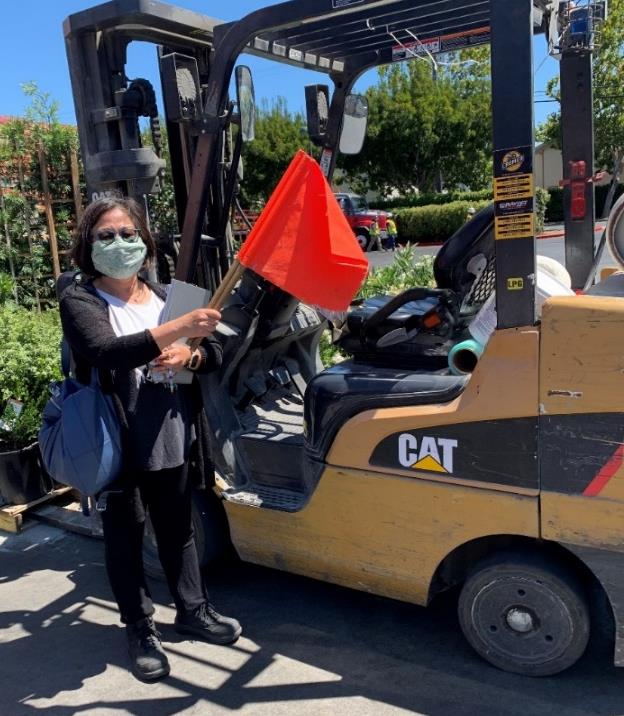
Exhibit 1. CA/FACE investigator J. Chan displaying spotter flags. in front of the CAT® forklift used in the incident. Photo by CA/FACE program.
- Ensure there is clear communication between the spotter and the operator
- Sound the horn at each intersection to let customers and associates know they are approaching
- Stop moving equipment immediately if anyone, including another associate, enters the exclusion zone.
Spotters must also adhere to the following standards:
- At least one spotter with flags must escort the lift equipment any time it moves on the sales floor, customer loading zones, the parking lot or wherever there is customer access
- Ensure that no one enters the exclusion zone when lift equipment is moving—including the spotter
- Visually assist the operator, as needed, to ensure the safe placement and removal of the load. This includes identifying any product that has shifted in the adjacent aisle racking due to the load placement, which can lead to an unsafe condition
- Immediately alert the operator if the load becomes unbalanced or unstable
- Continue spotter responsibilities until the lift operator completes the task and stops the lift equipment
- Maintain clear communication and frequent eye contact (every few seconds) between the spotter and operator while the lift equipment is in operation
- The training records of both the forklift operator and the victim were reviewed as part of this investigation, and the records indicated that both individuals successfully completed all the classes in which they participated. No employees had been trained in First Aid/CPR.
Worker Information
Equipment
The primary piece of equipment involved with this incident was a CAT® model 2C6000 forklift (Exhibit 2). The forklift is a relatively small indoor/outdoor, liquid propane fueled forklift that has a lifting capacity of about 6000 pounds and weighs about 9,440 pounds. Safety features include overhead guards (to protect the driver from falling objects), side/rearview mirrors, a backup alarm, strobe lights and a loud, audible horn.
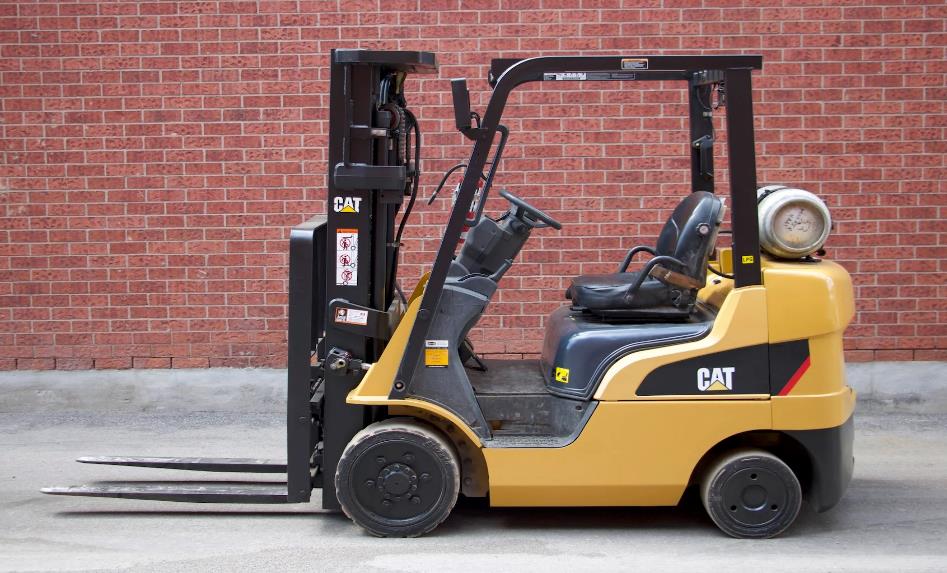
Exhibit 2. A CAT® model 2C6000 forklift (similar model, not actual used in the incident). Photo by CA/FACE program.
Incident Scene
Weather
The weather on the day and time of the incident was approximately 50 degrees Fahrenheit, with a southernly average wind speed of about 3 mph [Weather Underground]. The weather is not believed to have been a contributing factor in this incident.
Investigation
The incident was close to the end of the victim’s shift. He began work at approximately 9:00 p.m. on the night shift, and was due to end his shift around 6:00 a.m. According to witness statements, the victim was a spotter assisting the forklift operator who was attempting to unstack the top pallet of cased bottled water from a double stacked pallet approximately 9.5 feet high. The pallets were both individually shrink wrapped. As the forklift operator tried to remove the top pallet, the forks contacted an interior portion of the pallet, pushing it backwards slightly and causing it to tilt at a slight angle. The cased water on the top pallet further shifted against the shrink wrap, which gave way and dumped the entire pallet of cased water on the victim.
The forklift operator did not realize the victim was behind the pallet, and it was a couple of minutes before he noticed that he was under the cases of bottled water that fell. Calling for help, the operator and several co-workers moved the victim, who was unresponsive but breathing, away from the water and called emergency services. CPR was not initiated until the paramedics arrived on the scene, and they were unable to revive the victim who died from his injuries at the scene.
The incident was captured on CCTV and showed both the victim walking behind the pallet and the forklift operator repositioning the forks and attempting to unstack the pallet. The victim was standing between the unstable pallet (a few feet away) and a wall and was not visible from the forklift operator’s position. Video evidence indicated that the victim had not adhered to the company SOP by standing within the exclusion zone while the forklift was operating. It also appeared that neither the operator nor the victim was in verbal communication with each other.
Following the incident, the forklift was taken out of service and was evaluated by a 3rd party vendor to determine if there were any mechanical problems with the equipment (none were found). The investigation also revealed that while the company SOPs did address unbalanced or unstable (palletized) loads, they did not describe what to do when such an occurrence is encountered, other than alerting the operator.
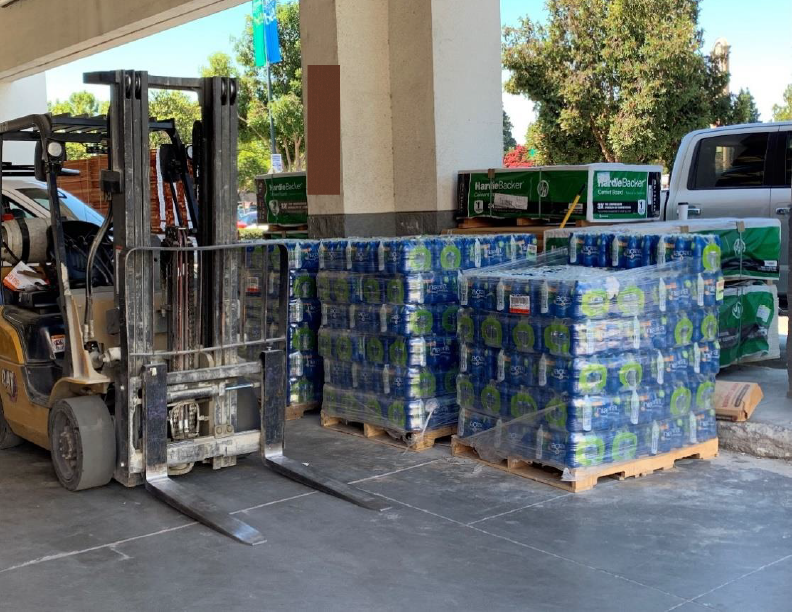
Exhibit 3. Incident location with CAT® forklift (similar model, not actual used in incident) and pallets of product identical to those that struck the victim. Photo by CA/FACE program.
Cause of Death
The county coroner listed the primary cause of death as multiple blunt force crush injuries to the torso and acute ethanol intoxication as a contributing factor.
Contributing Factors
- The victim was inexperienced and did not adhere to his safety training by standing within the exclusion zone while the forklift was in operation
- The forklift operator and victim were not within line of sight or communicating with each other per company requirements
- The victim was acutely intoxicated with alcohol at the time of the incident
- No employees on duty at the time of the incident had adequate training and instruction related to First Aid/medical emergencies
- The employer’s SOPs did not address methods to secure unbalanced or unstable palletized loads
Recommendations
Discussion: In this incident, the victim placed himself within the exclusion zone of a forklift attempting to move an unstable load, contrary to the training and instruction that he received. Further, he stood in a location that offered no eye contact with the forklift operator.
In addition to establishing an exclusion zone as a component of a standard for operating lift equipment and providing both training and instruction on the requirements of that standard, an employer must also ensure that supervisory staff are enforcing these requirements. This is especially important with inexperienced staff who may not realize the performance expectations associated with safety requirements.
The exclusion zone established by the employer is defined as 10 feet in the direction the lift equipment is moving and four feet on all other sides. If the victim had not been standing so close to an unstable pallet, this death would likely have been prevented.
Recommendation #2: Establish exclusion zones around the lift equipment, and train employees to stay outside of the zones at all times.
Discussion: In this case, the post-mortem toxicology report was positive for acute ethanol intoxication. While the coroner’s report stated that the cause of death was multiple blunt force crushing traumas to the torso, it also listed acute ethanol toxicity as a contributing factor. Ethanol intoxication can lead to a number of physical and behavioral conditions, including both acute and chronic effects on the cardiovascular system, decreased body temperature, decreased attention, impaired memory, disorientation as well as significant impairments in motor coordination, decision-making and impulse control4. The victim’s post-mortem blood alcohol level was high, and he may have placed himself in an unsafe position as a result of impaired judgment. It is not known if the victim had ever been observed by managers or co-workers to have work task impairment or suspected to be intoxicated.
As in this incident, it is recommended that employees who work with potentially dangerous equipment are free from drug and alcohol impairment that could endanger themselves or others. Pre-employment, periodic, and random drug testing programs can be effective in identifying employees who are at risk of drug-related work impairment or at greater risk of injury and illness. Employers implementing applicant or employee drug testing programs should develop and communicate clear policies that are permissible under the law, and legal consultation is recommended. Had such a program been in place, the risk of alcohol contributing to his death may have been minimized.
As described by the National Institute for Occupational Safety and Health (NIOSH), a Workplace Supported Recovery (WSR) program can be valuable in preventing and responding to substance abuse problems in the workplace ( Centers for Disease Control and Prevention – Workplace Supported Recovery Program). A WSR program can:
- Prevent work-related injuries and illnesses that could lead to the initiation of substance misuse
- Decrease difficult working conditions or work demands that might lead to daily or recurrent pain
- Provide information and access to care for a substance use disorder when it is needed, including access to medication-based or medication-assisted treatment, together with individual counseling
- Support second-chance employment
- Provide workplace accommodations and other return-to-work assistance
- Provide peer support and peer coaching to bolster the social supports available to workers in recovery
- Promote a work culture and climate that is supportive of workers in recovery (for example, awareness building, stigma reduction, and alcohol-free and health-focused work social events)
Workplaces can engage in several activities to mitigate the risk factors for initiation or perpetuation of a substance use disorder, help maximize the likelihood that employees in need will seek treatment, and support employees in their recovery efforts. If the victim had been enrolled in a WSR program, this death might have been prevented.
Recommendation #4: Train a number of employees in First Aid/CPR so that first aid is available to all employees on every shift.
Recommendation #5: Employers with retail warehouse operations should include a method for correcting (manually breaking down and restacking merchandise on) unstable or unbalanced pallets in their Standard Operating Procedures (SOP).
Discussion: While the SOPs of this particular employer did mention that unbalanced and/or unstable loads Were potentially hazardous, there was no written procedure for correcting the unbalanced loads. A procedure for correcting unbalanced/unstable loads should address the following:
- Once encountered, do not attempt to move a pallet with an unbalanced/unstable load
- Obtain assistance from one or more co-workers
- Manually remove (break down) cases from the unbalanced/unstable pallet and either hand truck to destination; or
- Transfer the load to a new pallet
When palletizing stock, the following should be considered to maximize pallet load stability:
In this incident, the forklift’s forks were placed under the top pallet which created a tilted, unstable load. If a method had been used to manually break down the unbalanced/unstable pallet, this death could have been prevented.1. Pallet Utilization:
The standard GMA8 pallet dimensions are 40 × 48 inches. Products loaded onto a pallet should utilize as much of that space as possible without product overhang at the edges. Unused space on the pallet allows products to shift when the pallet is moved, causing instability.
2. Limit Pallet Weight:
A standard wooden GMA pallet has a maximum load capacity of 2500 pounds, although some pallets, including those made of durable plastic, have higher capacities. A pallet’s load stability will be compromised if the weight of the load exceeds the weight capacity of the pallet. Exceeding the pallet load capacity should be avoided.
3. Weight Distribution:
How the weight of the products on a pallet is distributed also makes a difference in pallet load stability. The lower the center of gravity of the products on the pallet, the more stable the load will be overall. Top-heavy loads can fall off pallets and unbalanced loads can break pallet boards. Pallet load stability requires heavier products be evenly distributed as close as possible to the pallet deck.
4. Stack Height:
The maximum safe height that products can be stacked on a pallet isn’t related to the weight of the load, rather, it is based on the forklift operator’s ability to see over or around the pallet while driving and on the dimensions of the storage racks in the warehouse. A safe height for a pallet stack handled by a standard forklift in most warehouses is about 60 inches, or five feet.
5. Pallet Wrapping:
Once a pallet is loaded, the components of the load will have to be bound tightly to each other and to the pallet. This is usually accomplished using plastic shrink wrap. Wrapping should take place from the bottom to the top of the stack in order to bind the load together and cover all four corners of the pallet. If the materials on the pallet are particularly heavy, straps binding the load to the pallet should be considered.
Disclaimer
Mention of any company or product does not constitute endorsement by CA/FACE and the National Institute for Occupational Safety and Health (NIOSH). In addition, citations to websites external to CA/FACE and NIOSH do not constitute NIOSH endorsement of the sponsoring organizations or their programs or products. Furthermore, CA/FACE and NIOSH are not responsible for the content of these websites. All web addresses referenced in this document were accessible as of the publication date.
References
Cal/OSHA [2020] T8CCR §3203. Injury and Illness Prevention Program.Oakland, California. Cal/OSHA / Division of Occupational Safety and Health.
Cal/OSHA [2018] T8CCR §3664(e). Operating Rules. Oakland, California. Cal/OSHA / Division of Occupational Safety and Health.
Cal/OSHA [2018] Title8CCR §3400(b) Medical Services and First Aid. Oakland, California. Cal/OSHA / Division of Occupational Safety and Health.
California Commission on Peace Officers Standards and Training [2017]. “First Aid, CPR and AED." (PDF)
Intelligent Global Pooling System| Food Logistics Blog [2020]. “How to Ensure Pallet Load Stability."
LaHood, A.J., et al [March 2022]. “Ethanol Toxicity" National Library of Medicine.
Mayo Foundation for Medical Education and Research [2022]. “Alcohol poisoning - Symptoms and causes."
National Institute on Alcohol Abuse and Alcoholism [May 2021]. “Understanding the Dangers of Alcohol Overdose."
National Institute for Occupational Safety and Health [July 2020]. "Workplace Supported Recovery Programs."
Weatherspark.com [2022]. Historical Weather on Saturday August 21, 2021 in Stockton California.
Investigator Information
This investigation was conducted and authored by Robert Kleinerman, MPH, CIH, Fatality Investigator/Consultant, and Jacqueline Chan, MPH, CDPH Industrial Hygienist. Additional contributions to the report were provided by Robert Harrison, MD, MPH, CDPH FACE Project Officer; Laura Styles, MPH, FACE Research Scientist; and Glenn Shor, PhD, Cal/OSHA CFOI Program.