





Office of aids

The California Department of Public Health (CDPH) values the health of all Californians. There are an estimated 220,000 Trans/Transgender/Gender Non-Binary adults in California.1
Everyone has a gender, a gender identity, and a gender expression. No two individuals experience their gender, gender identity, or gender expression the same way.

Inclusive umbrella terms for individuals whose gender identity or expression (masculine, feminine, other) is different from their sex (male, female) at birth, assigned male at birth (AMAB) or assigned female at birth (AFAB).

Refers to one’s internal understanding of one’s own gender, or the gender with which an individual identifies.

A term used to describe individuals’ outward presentation of their gender.
Gender identity and sexual orientation are different facets of identity. Everyone has a gender identity and a sexual orientation, but an individual’s gender does not determine an individual’s sexual orientation. Trans/Transgender/Gender Non-Binary individuals experience their sexual orientation in multiple expressions.
Inclusive Language
Inclusive language is a way of acknowledging and respecting the diversity of bodies, genders, and relationships. People express their gender and sexuality in different ways. People can have different biological sex characteristics. Inclusive language ensures we don't leave people out of our conversations or our work. This includes both when we are communicating directly with someone and when describing someone who isn't present. Inclusive language acknowledges the diversity of people we work with and serve, and can be a path to understanding one another, what we have in common, and our differences in lived-experiences. For more information on inclusive language, please visit the LGBTQIA Resource Center.

Transgender individuals, particularly transgender women of color, have higher rates of HIV infection. Rates are especially high among African American and Latinx/e transgender women.
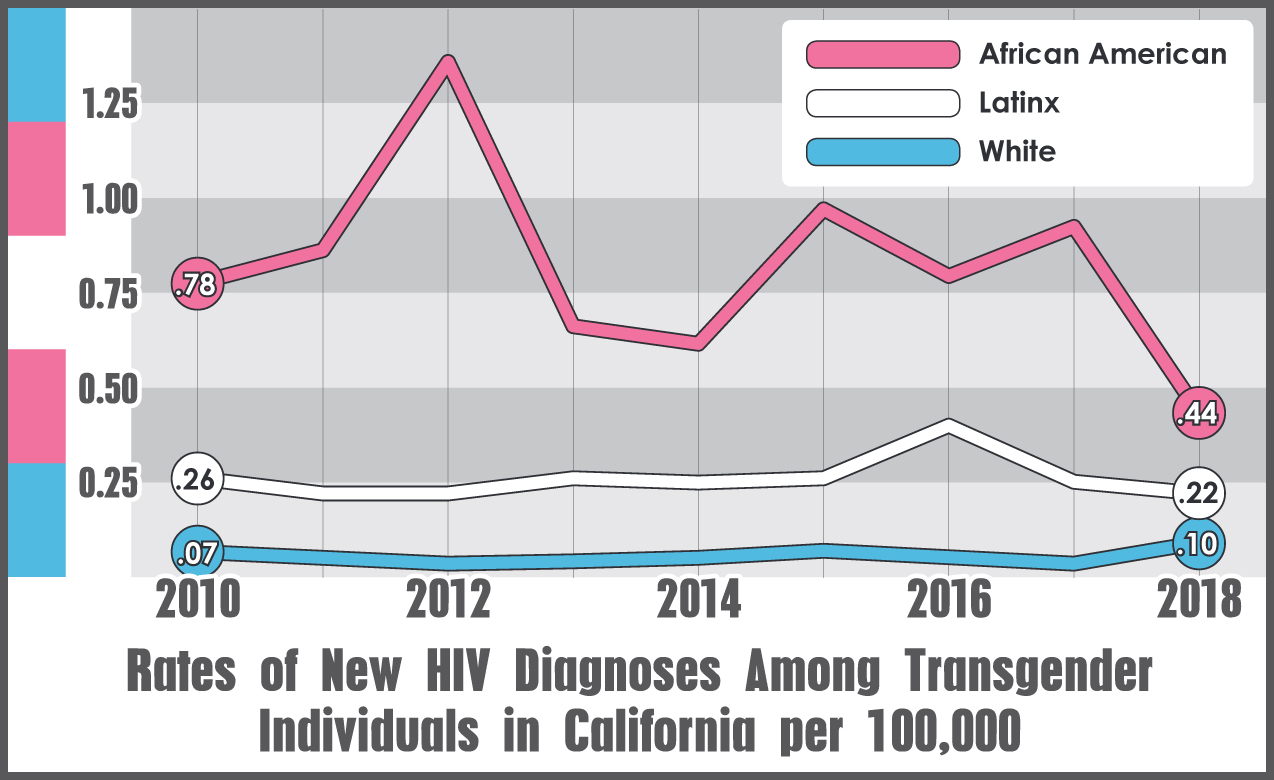
In 2018, 86 percent of transgender individuals who received an HIV diagnosis were transgender women. Although rates among transgender individuals are not available, it is estimated that both transgender women and men are disproportionately affected by HIV. According to an analysis conducted by CDC scientists, HIV prevalence among transgender individuals in the US is estimated to be 9.2 percent overall, and higher among transgender women (14.1 percent) than transgender men (3.2 percent).
The higher HIV prevalence among transgender women compared to other high risk groups may be due to many environmental and social contexts including multiple stigmas (transphobia, racism, sexism, HIV, and sex work); substance use; recurrent incarceration and victimization in the criminal justice system; homelessness and marginal housing; relationship and other forms of violence; institutional inattention, indifference, and mistreatment; mental health issues; lack of economic opportunities; and other issues.2
Transwomen are disproportionately affected by the HIV epidemic and are in immediate need of comprehensive HIV preventative services. A recent survey published by the CDC estimates 1 in 4 transwomen are living with HIV. These health disparities are compounded by the intersexuality of racial/ethnic identity. The full CDC report:
HIV Infection, Risk, Prevention, and Testing Behaviors Among Transgender Women - National HIV Behavioral Surveillance - 7 U.S. Cities, 2019-2020 (PDF).
HIV Surveillance Reports
-
California HIV Surveillance Report – 2022 (PDF, 2.8MB)
-
California HIV Surveillance Report – 2021 (PDF, 1.1MB)
-
California HIV Surveillance Report – 2020 (PDF, 1.2MB)
-
HIV and Transgender People in California, 2020 (PDF)
- HIV and Transgender People in California, 2019 (PDF)
- HIV and Transgender People in California, 2018 (PDF)
The Trans Reality infographic listed below further highlights barriers Transgender individuals experience.
 Trans Reality Infographic (PDF)

What is HIV PrEP?
Pre-exposure prophylaxis (PrEP) is a highly effective HIV prevention strategy in which an individual takes a medication to stay HIV negative. PrEP is available as a pill and as a long-acting injection. There are two pill formulations: 1) TDF/FTC (brand name Truvada) and 2) TAF/FTC (brand name Descovy). The long-acting injection (a shot) is called cabotegravir (brand name Apretude) and is administered by a medical provider in-clinic approximately every 2 months. PrEP is available by prescription from a health provider who can review these options with you. PrEP is highly effective when taken as prescribed in addition to being very safe and well-tolerated. Most private health insurance, as well as Medi-Cal and Medicare, covers PrEP. If you need help with paying for PrEP or finding a provider, there are assistance programs that can help. The
California PrEP Assistance Program (PrEP-AP) helps Californians access and pay for PrEP services.
HIV PrEP works for women, men, people of transgender experience, people of all sexual orientations and gender identities, youth, and people who inject drugs.
You can use PrEP alone or in combination with other HIV prevention tools like condoms and
U=U to have the sex you want and reduce your chances of getting HIV!
PrEP for Trans Women | PleasePrEPMe
Results from two California transgender focused HIV PrEP studies to increase HIV PrEP uptake, adherence, retention, and access for transgender communities from 2016-2020 can be found on the Journal of Acquired Immune Deficiency Syndrome's webpage:
- Expanding the Pie-Differentiated PrEP Delivery Models to Improve PrEP Uptake in the San Francisco Bay Area
- Uptake, Retention, and Adherence to PrEP in Triumph: A Peer-Led PrEP Demonstration Project for Transgender Communities in Oakland and Sacramento, California
What is HIV PEP?
Post-exposure prophylaxis (PEP) is a biomedical HIV prevention method that commonly consists of a 28-day course of antiretroviral medications taken after an HIV exposure. HIV PEP is most effective when taken as soon as possible after an HIV exposure, and adherence is crucial to the drug therapy’s success. When taken as prescribed, PEP can reduce HIV transmission by 80%. Despite the timing of taking PEP being crucial to its success, many barriers to accessing PEP prevent people for receiving the drug therapy in a timely manner. The California PrEP Assistance Program (PrEP-AP) has Immediate Access assistance that can help Californians access and pay for PEP. Another option is to already have a prescription available, “PEP in Pocket or PIP.” For someone who could have an HIV exposure but cannot routinely be on PrEP, this is a reasonable back-up plan.
What is doxy-PEP?
Doxycycline post-exposure prophylaxis (doxy-PEP) is a bio-chemical way to prevent bacterial sexually transmitted infections like chlamydia (CT), gonorrhea (GC), and syphilis.3 Sexually active persons take a single, 200 mg dose of the antibiotic, doxycycline, after having condomless oral, anal, or vaginal sex to significantly reduce catching CT, GC, and/or syphilis. It is best taken within 24 hours (but can be taken up to 72 hours). No more than once dose per day (24 hours) should be taken. It can be used in combination with HIV PrEP, HIV PEP, and/or gender-affirming hormonal therapy.
More Information on STI Prevention
- Guidelines for the Use of Doxycycline Post-Exposure Prophylaxis for Bacterial STI Prevention
- CDPH doxy-PEP Recommendations for Prevention of STIs (PDF)
- Doxy-PEP Locator
-
California STI Screening Recommendations for Transgender and Gender Diverse Persons
-
Vaccine Schedules and Recommendations for Gay, Bisexual and Other Men who have sex with Men, Sexually Active People, and Adults with HIV

International Transgender Day of Visibility
Observed each year on March 31, this day is dedicated to celebrating transgender individuals and raising awareness of discrimination faced by transgender individuals worldwide, as well as a celebration of their contributions to society.
National Transgender HIV Testing Day
Observed each year on April 18, this day is an opportunity to recognize the importance of routine HIV testing and status awareness, as well as HIV prevention and patient-centered care for transgender and gender non-binary individuals.
International Non-Binary People’s Day
International Non-Binary People's Day is observed each year on 14 July and is aimed at raising awareness and organizing around the issues faced by non-binary people around the world. The day was first celebrated in 2012, started by Katje van Loon. The date was chosen for being precisely midway between International Men's Day and International Women's Day.
California Transgender History Month
California's State Assembly voted in favor of House Resolution 57 establishing that August will be recognized as Transgender History Month starting in 2024 — and making it the first state to honor trans history with such a designation.
Transgender Awareness Month
The month of November celebrates the transgender and gender nonconforming communities and raises awareness for the community through education and advocacy activities.
Transgender Awareness Week
Observed November 13 – 19 each year, people and organizations around the country help raise the visibility of transgender individuals and address issues members of the community face.
Transgender Day of Remembrance
Transgender Day of Remembrance is an annual international observance on November 20 that honors the memory of the transgender individuals whose lives were lost in acts of anti-transgender violence and transphobia that year.
National LGBTQ Health Awareness Week
The Annual LGBTQ Health Awareness Week, a nationwide event that promotes the unique health and wellness needs of the lesbian, gay, bisexual, trans, and queer/questioning (LGBTQ) community.
International Day Against Homophobia, Transphobia, and Biphobia
The International Day Against Homophobia, Transphobia, and Biphobia is observed each year on May 17th. It was created in 2004 to draw attention to the violence and discrimination experienced by lesbian, gay, bisexual, trans, intersex people, and all other people with diverse sexual orientations, gender identities/expressions, and sex characteristics.
International Pronouns Day
Observed the 3rd Wednesday of October, International Pronouns Day seeks to make respecting, sharing, and
educating about personal pronouns commonplace. Referring to people by the pronouns they determine for themselves is basic to human dignity.
International Day to End Violence Against Sex Workers
The International Day to End Violence Against Sex Workers is held annually on December 17th by sex workers, their advocates, friends, families, and allies. The day calls attention to hate crimes committed against sex workers worldwide, as well as the need to remove the social stigma and discrimination that have contributed to violence against sex workers.

State of California
California law prohibits health plans from denying health care or discriminating against individuals because of the individual's gender, including gender identity or gender expression. In 2023, California implemented the
Transgender, Gender Diverse, and Intersex (TGI) Inclusive Care Act, which protects the right of Californians to access gender-affirming health care services.
California Department of Public Health
Department of Managed Health Care
Department of Health Care Services
Department of Insurance
Department of Justice
-
California Department of Justice - State of Pride Report 2024 (PDF, 7.0MB)
-
California Department of Justice - State of Pride Report 2023 (PDF, 1.9MB)
Vital Records
Community
- Center of Excellence for Transgender Health
- The TransLatin@ Coalition
- Transgender Health and Wellness Center
- Transgender Law Center
- Gender Spectrum
- Every Woman California - Resources for LGBTQ+
- Health Consumer Alliance: Access Coverage
- Project Health - TransLine
- The Gender Cool Project
- Transgender Resources - The Source LGBT+ Center
Research
- 1How Many Adults Identify as Transgender in the United States? - The Williams Institute, 2016 (PDF)
-
3Postexposure Doxycycline to Prevent Bacterial Sexually Transmitted Infections
Federal
Centers for Disease Control and Prevention (CDC) Resources
New Reports: HIV Prevention and Care Among Transgender Women
- Overview and Methodology of the National HIV Behavioral Surveillance Among Transgender Women
- Characteristics Associated with Pre-Exposure Prophylaxis Discussion and Use Among Transgender Women Without HIV Infection
- Structural and Psychosocial Syndemic Conditions and Condomless Anal Intercourse Among Transgender Women
- Nonprescription Hormone Use Among Transgender Women
- Transgender Women Experiencing Homelessness
- Prevalence of Discrimination and the Association Between Employment Discrimination and Health Care Access and Use
-
Social Support and the Association Between Certain Forms of Violence and Harassment and Suicidal Ideation Among Transgender Women
Other CDC Resources
- Issue Brief: HIV and Transgender Communities Strengthening Prevention and Care
-
Toolkit for Providing HIV Prevention Services to Transgender Women of Color