



Prenatal screening program


Only patients who participate in the California Prenatal Screening (PNS) Program will have access to free follow-up genetic counseling and diagnostic services at a state-contracted Prenatal Diagnosis Centers for a pregnancy determined to be high-risk.
The California Prenatal Screening (PNS) Program offers low program fees that are reimbursed by Medi-Cal and most California health insurance plans, with no cost sharing (copayment, coinsurance, or deductible).

The California Prenatal Screening (PNS) Program has not and does not prevent or limit providers from ordering screening tests not provided through PNS Program, including screenings for sex chromosome abnormalities and other genetic conditions.
California Prenatal Screening Program
Effective immediately, we are updating our process for mailing non-urgent paper test results due to an unforeseen conflict/contract termination with our print vendor. There will be delays in the mailing of hard copies of results for both Newborn and Prenatal Screening Programs. Communication of all positive and urgent cases to providers is unaffected by this issue, and continues to take place through the area service centers (ASCs) or case coordinator centers (CCCs). Here’s what you need to know:
- Newborn Screening Results:
- Hospitals and facilities can elect to receive newborn screening results electronically by establishing a dedicated email address to receive the NBS results. To participate, please email nbs@cdph.ca.gov to receive an application and instruction guide.
- Prenatal Screening Results:
- Manual/Two-Page Requisition Form Orders: Paper result mailers will continue to be sent for Prenatal Screening orders placed using manual or two-page requisition forms.
-
CalGenetic Portal Orders: For providers who placed orders through the CalGenetic Portal, results will be available electronically as soon as they are ready. However, paper results will not be mailed for the foreseeable future.
Thank you for your understanding during this time. If you have any questions, please reach out to our support team.
The California Prenatal Screening Program is a statewide program offered by prenatal care providers to all pregnant individuals in California. Prenatal screening uses a pregnant individual's blood samples to screen for certain birth defects in their fetus (developing baby).
.jpg "Positive pregnancy test")
Individuals with a fetus found to have an increased chance of one of those birth defects are offered genetic counseling and other follow-up services through state-contracted Prenatal Diagnosis Centers.
Medi-Cal or private health insurance must cover the program fees with only a few exceptions for self-insured employers and out-of-state health plans. There is no co-payment, co-insurance, deductible, or any other form of cost sharing, required of covered families.
Prenatal screening is your choice. Those who choose to participate can get one or two blood samples collected for two types of prenatal screening. Both screenings are recommended since they screen for different genetic conditions or birth defects. These two screenings are offered:
- Cell-free DNA (cfDNA) screening; and
- Maternal serum alpha-fetoprotein (MSAFP) screening.
Genetic conditions and birth defects screened for are these:
- Down syndrome (trisomy 21)
- Trisomy 18
- Trisomy 13
- Neural tube defects, like spina bifida
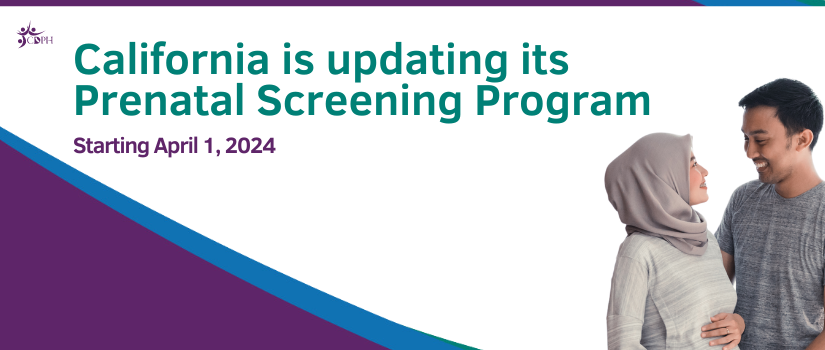
Starting April 1, 2024, the CA PNS Program has added sex chromosome aneuploidies (SCAs) – also referred to as X and Y chromosome variations – to the state cell-free DNA screening panel. Since April 1, 2024, the California Prenatal Screening Program also screens for the following genetic conditions:
- Turner syndrome
- Klinefelter syndrome (XXY)
- Trisomy X
- XYY
Videos
Find out more about prenatal screening from our videos in English, Spanish, and Chinese below!
|
English Video |
Spanish Video |
Chinese Video |
|---|---|---|
|
|
|
|
|
Title: California Prenatal Screening Program and Luisa’s Decision Language: English Published: 8/11/2022 Duration: 3:29 |
Title: Programa de Detección Prenatal de California: La decisión de Luisa Language: Spanish Published: 8/29/2022 Duration: 4:14 |
Title: 加州产前筛查计划及路易莎的决定 Language: Simplified Chinese Published: 9/20/2022 Duration: 3:59 |
Program Profile
Our Goal
We make prenatal screening available to all pregnant individuals in California through prenatal care providers at no or low cost to patients.
Our Work
We coordinate prenatal screening and access to follow-up, diagnostic services throughout the state; support and guide prenatal care providers; create and distribute supplies and educational materials; and contract with and provide quality control for labs used for screening.
Service Delivery
Prenatal screening uses a pregnant individual's blood samples to identify the chances of a fetus having one of several birth defects. If prenatal screening finds an increased chance of a birth defect in a fetus, genetic counseling and other follow-up services are available for the pregnant individual. Follow-up services include ultrasound exam and the diagnostic tests amniocentesis and chorionic villus sampling. Diagnostics tests give a clearer answer about birth defects.
We Serve
California's prenatal care providers are required to offer the Prenatal Screening Program to all pregnant individuals in California. Three out of four pregnant individuals choose prenatal screening offered through the state program. Many expecting parents want to know as much as they can about their fetus during pregnancy.
Funding
The Prenatal Screening Program is supported by program fees. Beginning in September 2022, the fees for screening are $232 for cell-free DNA (cfDNA) screening and $85 for maternal serum alpha-fetoprotein (MSAFP) screening. The cfDNA screening fee will increase to $344 on July 1, 2024.
Medi-Cal and private insurance must cover all program fees, with only a few exceptions. The exceptions are self-insured employers and out-of-state health plans.
For Individuals and Families
For Prenatal Care Providers
California provides the most comprehensive statewide prenatal screening program in the United States. Over 340,000 pregnant individuals participate in the state program offered by prenatal care providers every year.
Prenatal screening for certain birth defects through the state program is available to all pregnant individuals in Californians at no or low cost to program participants, but it is not required.
Prenatal care providers must provide information on prenatal screening through the state program to pregnant individuals. Those individuals who choose to participate in the California Prenatal Screening Program provide one or two blood samples through their prenatal care provider for two types of screening (as of September 2022). Both screenings are recommended since they screen for different birth defects.
Screening offered
- First trimester: cell-free DNA (cfDNA) screening (recommended from 10 weeks through first day of 21 weeks of pregnancy)
- Second trimester: Maternal serum alpha-fetoprotein (MSAFP) screening (from 15 weeks through first day of 21 weeks of pregnancy)
Birth defects screened for by the California Prenatal Screening Program:
Genetic Conditions
- Down syndrome (trisomy 21)
- Trisomy 18 (Edwards syndrome)
- Trisomy 13 (Patau syndrome)
Starting April 1, 2024, the CA PNS Program has added sex chromosome aneuploidies (SCAs) – also referred to as X and Y chromosome variations – to the state cell-free DNA screening panel. Since April 1, 2024, the California Prenatal Screening Program also screens for the following genetic conditions:
- Turner syndrome
- Klinefelter syndrome (XXY)
- Trisomy X
- XYY
Birth Defects
- Neural tube defects, like spina bifida and anencephaly.
For identified, high-risk individuals, the California Prenatal Screening Program offers genetic counseling, ultrasound exams, diagnostic testing at state-approved Prenatal Diagnosis Centers, at no additional charge. Amniocentesis and chorionic villus sampling are diagnostics tests that give a clearer answer about birth defects.
Services are provided by doctors, nurses, midwives, and other prenatal care providers working in hospitals, offices, clinics, and homes.
Educational Resources
- Education Resources for Individuals and Families web page
- Education Resources for Providers web page
- Prenatal Screening Patient Booklet - English (PDF)
- Spanish (PDF)
- Chinese, Simplified (PDF, 24.4MB)
- Korean (PDF)
- Tagalog (PDF)
- Vietnamese (PDF)
- Russian (PDF)
- Armenian (PDF)
- Farsi (PDF)
- Hmong (PDF)
- Punjabi (PDF)
- X and Y Chromosome Variations Insert - English (PDF)
- Patient Booklet Summary - English (PDF, 2 pages) The summary serves as an additional resource and should not be used as a replacement for the comprehensive PNS Program patient booklet. The patient booklet provides detailed information about the PNS Program, including consent and legal notices.
- Armenian (PDF)
- Chinese, Simplified (PDF)
- Farsi (PDF)
- Hmong (PDF)
- Korean (PDF)
- Punjabi (PDF)
- Russian (PDF)
- Spanish (PDF)
- Tagalog (PDF)
- Vietnamese (PDF)
- Prenatal Screening Patient Booklet in webpage format (use "select language" button in top right of web page to view in additional languages)
- Prenatal Screening Patient Glossary - English (PDF)
- Genetic Support Foundation Videos
Program Resources
- Birth Defects Screened for by the PNS Program
- Notice of Privacy Practices
-
Patient Billing and Information
-
Patient FAQ
-
Prenatal Diagnosis Centers by County
-
Provider FAQ
-
Sexual Orientation and Gender Identity Information Survey
-
Summary of Screenings
-
What Happens to Blood Samples After Prenatal Screening
External Resources
Related Programs
- Adolescent Family Life Program
- Black Infant Health Program
- California Diabetes, Pregnancy, and Postpartum Care
- California Home Visiting Program
- Children and Youth with Special Health Care Needs
-
COVID19 Vaccines and Pregnancy Guidance
- Maternal, Child, and Adolescent Health Division
-
Newborn Screening
- Preconception Health
-
Reproductive Health
-
WIC: California Special Supplemental Nutrition Program for Women, Infants, and Children